Tuesday, 27 December 2011

Qur'anic Criticisms of Various Modes of False Reasoning

This post will deal with the deception in winning a debate. In a battle or a debate of some sort you always need proofs to crush your opponent as is clearly the case in a court of law. But when people find they are out of proofs, they can resort to cheating mechanisms to deceive their oponent into thinking they have actually lost the argument. Clearly when someone resorts to cheating it shows immediately that they could not win a fair fight. The following show the various modes of cheating mechanisms that can and have been undertaken for false reasoning in examples from the Qur'an and even society today:


1) The threat of force in debate
This is simply when anger overtakes someone and they cannot refute the argument and so they resort to the cheating mechanism of threatening their oponent. For example when Ibrahim [as] challenged his people when he broke their idols. They responded by saying "Burn him and protect your gods if you do anything at all!" [21:68] They win the argument by using the threat of force in debate, but in turn it only prooves their actual defeat as they could find no other way to respond to his argument.


2) Character Assassination
This is when one is belittled in response to an argument when you cannot think of anything better to say. It's actually not a real response to an argument, it's an insult. The example from the Qur'an is when Firawn belittles Musa [as] because of his stutter: "Am I not better than This (Moses), who is a contemptible wretch and can scarcely express Himself clearly?" [43:52] Firawn used the idea of character assassination to belittle Musa and thus deceived himself and others into thinking he actually defeated him.


3) Stirring up an emotional crowd
This tends to be ok in sport, but in debate or discourse, clapping or cheering to support the speaker is not proof of an argument. The crowd cannot validate your response. As we know this is used a lot in contemporary debate, especially in politics. Again Pharaoh tried to use this to his advantage when he invited the nation to watch his battle against Musa [as]. This can be seen in the following verses from the Qur'an: "They said 'These two are certainly (expert) magicians: their object is to drive you out from your land with their Magic, and to do away with your Most cherished institutions. Therefore concert your plan and then assemble in ranks: He wins today who gains the upper hand'." [20:63-64]


4) To make the opponent question their own modesty or loyalty
 A clear example of this can be seen in the role of family pressures during cultural weddings. People will make you feel like you are disloyal because you don't conform to family practises. After all, the way a wedding is conducted says alot about your family and  culture. But when some Muslims struggle today between culture and Islam during weddings a key question that tends to pop up [especially amongst the south Asian Muslims at least] is "What are people going to say?" or in the case of Ibrahim [as] where his father said "We found our fathers worshipping them" [21:53] in response to Ibrahim questioning his father about the images to which he was devoted. Immediately the questionner implies where the opponents loyalty stands, this would not justify or validate an argument at all.

5) To rephrase the opponents position falsely and to refute it
Many a times we may have come across this - or heard a misquotation 'So what you're saying is...'Allah swt corrected the misquotation of Eesa being the son of God with this ayat clearly stating he is not the son of God: 'the similitude of Jesus before Allah is as that of Adam; He created Him from dust, then said to him: "Be", and he was.' [3:59]


6) Asking strategically distracting questions
This is something the Quraysh would do when questioning the Prophet pbuh to distract him from his original message. Sometimes we find our selves a victim of this when in dialogue with non-Muslims. We don't finish answering the actual question before other distracting questions are posed one after the other. We end up explaining to them what Islam is not rather than what it actually is. Surely whoever asks the questions, controls the conversation!


[This post was a write up of my notes from Nouman Ali Khan's Divine Speech Seminar in London Dec 2011]

Monday, 26 December 2011

Qur'anic Examples - The varying states of hearts

The purpose of an example is that it can help you to understand what the writer or speaker is actually saying. So what makes an example a good example? A good example is something that the whole audience can understand. Thus it is an example related to their time and their culture etc. The main purpose of examples in the Qur'an is so that one is left to ponder. It is written in such a way that one can be lost in thought, thus through one example in the Qur'an many lessons are learnt.

The following ayaat from the Qur'an will show how lessons are truly learnt from the examples provided and how they are relevant to the people of their time thus refuting the arguments put forth by non-muslim academics who critique the examples portrayed in the Qur'an.

Thenceforth were your hearts hardenend: They became like a rock and Even worse in hardness, for among rocks there are some from which rivers gush forth; others there are which when split asunder send forth water; and others which sink for fear of Allah, and Allah is not unmindful of what you do.


The ayat above is in reference to the 3 kinds of hearts in which an example of the rock is given. The 3 kinds of rock are as follows:
1) The rock that bursts open and water gushes out of it
2) The rock that cracks open and a small amounts of water seeps out of the crack
3) The rock that falls from the fear of Allah

If this example of the rock is in reference to the heart, then the heart which falls from the fear of Allah (the 3rd rock) is like being in the fold of Islam. The heart which cracks open (the 2nd rock) and the little water comes out is when a person is in the state of Imaan. The heart which bursts open (the 1st rock) and water gushes out is when one is in a state of Ihsaan.

To further understand this, let's take the example of Umar ibn al Khattab's conversion to Islam. It wasn't until the 6th year after the Prophet pbuh's first revelation that Umar came to Islam. So at first his heart was hardened like the rock. It only cracked open a little when he went out with intent to kill the Prophet pbuh; he found the Prophet pbuh by the Ka'bah praying and the words of the Qur'an moved him that he changed his mind. It was later on when he found out his sister had converted to Islam that he returned home and once he heard the message of the Qur'an that his heart [the rock] cracked open and the faith poured out. Faith inside the heart is like water in the rock.

Whilst this example above portrayed an analogy of the states of our hearts, the actual example Allah chose about the rock and comparing it to the varying states of the heart was for a specific reason and a specific audience. This particular verse is taken from Surah al-Baqarah in which Allah addresses as we know Bani Israeel. This example was thus given to Bani Israeel. Why? Because they already know the example of when water gushes out of the rock! [When Musa alayhi-salaam hit his stick on the rock and the 12 springs gushed forth - Quran 26:63]. Therefore, Allah swt used the example  they [Bani Israeel] were already aware of! SubhanAllah! Who better to give an example to His creation than the Creator Himself!

[This post was a write up of my notes from Nouman Ali Khan's Divine Speech Seminar in London Dec 2011]

Tuesday, 20 September 2011

Eid in Makkah

Witnessing Eid takbeer with the ummah was by far the most memorable experience of this trip. Below is a video I managed to sneak in whilst getting front row seats near the ka'bah.


Monday, 19 September 2011

In search of Laylat-ul Qadr-the night of power

27th Aug 2011 - - - 1 am

As we settled ourselves into our routines in Makkah, I was faced with tests. I think the hardest of all was my father becoming ill and hospitalised. Alhamdulillah for the support I had around me as well as the power of dua: praying that he would be ok. Alhamdulillah, Alhamdulillah for the amazing people I got to know that really stuck by my in my weakest of moments. By the grace of Allah swt, my father became better quickly even though the infection on his leg was at its worst, the hospital he was at in Makkah treated the problem very well!

Perhaps due to my father's illness, I began to feel quite tired. I hadn't performed tawaaf for 2 days now. It felt strange. But I was fulfilling a daughter's role which in itself was a form of ibadah. The number of people in Makkah had increased considerably! We returned from the hospital later that night to stand in Qiyam prayer on the night of the 27th of Ramadhaan. My dad had warned me that it will be extremely crowded and not to perform tawaaf but go for prayer instead. As we walked towards the masjid, after the taxi had dropped us by the hotel. The saff or rows of people had reached and extended far back into the street. We tried to weave our way through the rows in order to find a place near other women as the prayer had begun. Finally we found a spot to pray. I stood at the end of the short row of women, there was a small gap and the men's row continued on stretching across the street. After 4 raka'at of the Qiyam prayer, I noticed I could hear some noise during the prayer. I tried to remain focused until the  crowd that was making its way through the rows, literally breaking through them in order to to exit through the street. I didn't understand what was going on. I could feel elbows hitting my arm, until I was swung back from my row but quickly caught my balance. I couldn't help but break my salaah at that point as I witnessed my first stampede. My bag with my mobile phone - my only means of contacting my father and family - was tangled between the feet of those heading home and then I noticed my shoes were missing! I managed to free my back and walked back a few rows with the crowd to find of my shoes in the bag on a man's prayer-mat. I asked him if he had seen my other shoe. He just smiled in amusement. I looked in the row behind and there it was! With a sigh of a relief I returned back to my row, quite shaken by what had just happen.

For the remainder of the night, I secretly wished it wasn't laylatul Qadr as I felt my peace had been broken. Further to that, I was became more irritated by the attitude of some of the people. But soon I felt so guilty for even having such a thought. Alhamdulillah, later speaking to my father about this situation, he advised me to concentrate on my salah and ibadah [worship]and ignore all that happens around me. I remembered that advise throughout the remainder of my time there. May Allah swt accept all our ibadah and repentance. Ameen!

Saturday, 17 September 2011

A snapshot of Hajj...

22nd Aug 2011 - - - 3pm

Continuing our tour from Arafaat we headed to Muzdalifah, the place where the pilgrims stay for 1 night and collect usually small pebbles or stones to then trow at the walls in jamarat representing the devil. The jamarat, my father tells me can become very dangerous due to the immense crowds during Hajj time. In fact the Saudi's have now built 5-storey bridges to enable as many people to throw stones and fulfill their Hajj ritual rites.

5-storey bridge of Jamaraat
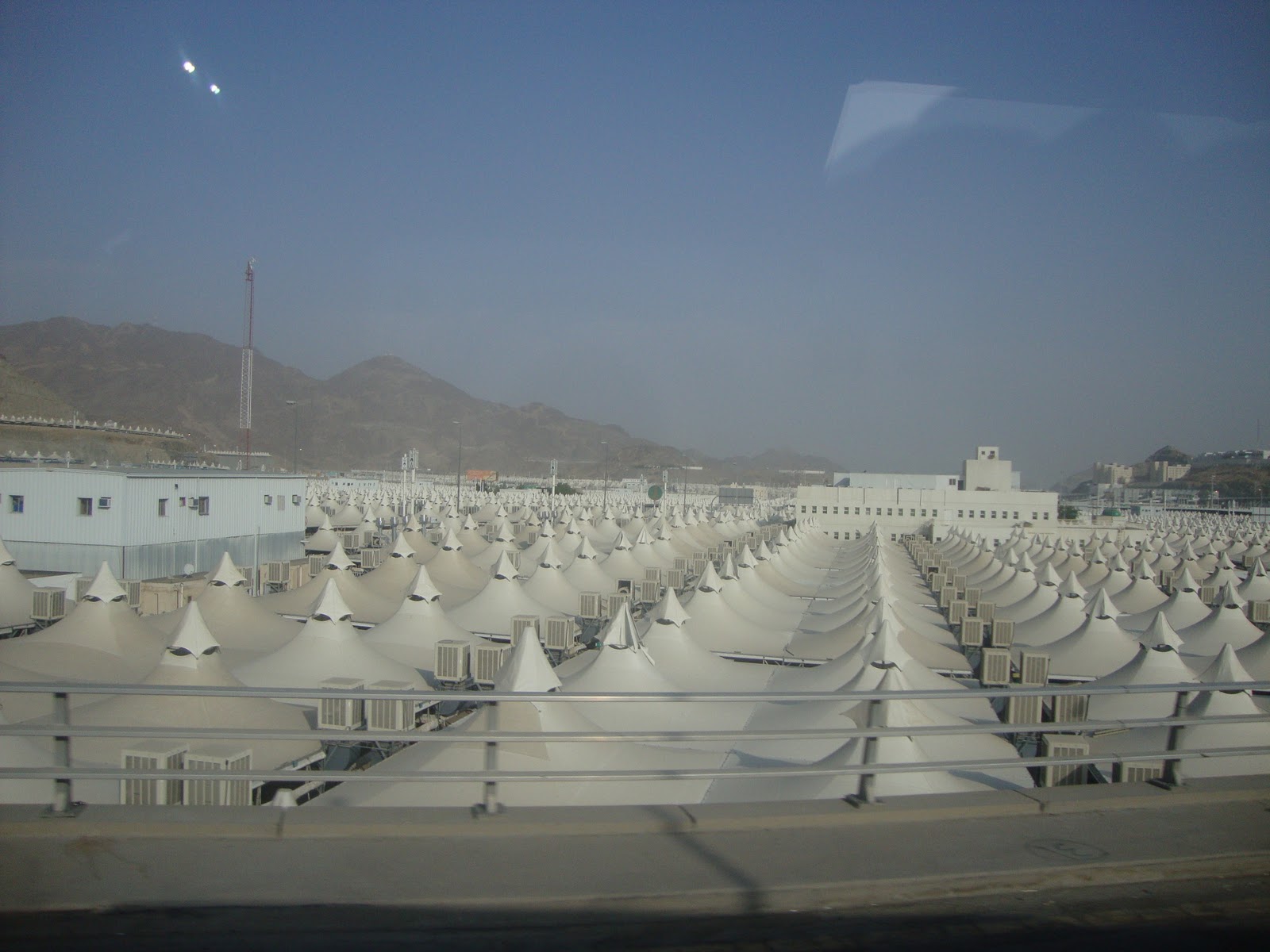
 Moving on swiftly, still in the coach we headed to Mina. The fire-proof tents in Mina provide shelter to approximately 5 million Muslims each year during the Hajj season. The view was amazing!
Fire-proof tents in Mina

Close up of tents in Mina
 It was an amazing site seeing and learning the rituals for Hajj. It made me think of my mum. I now understand why she becomes so tearful thinking of her experience at Hajj, subhanAllah! After leaving Mina, we headed back towards our hotel in Makkah. On our way we passed by Jabal or the mountain of Noor. This was the same blessed mountain, the Prophet pbuh would espcape to to contemplate and think about God. It was here that Jibraeel came with the first revelation of Iqra or Read. SubhanAllah! I really wanted to climb the mountain. I could see some women and men climbing the mountain, but my father said, I'd get too tired! InshAllah on my next visit! :)
Cave Hira on Jabal Noor.

Tuesday, 13 September 2011

Sight-seeing in Makkah

22nd Aug 2011 - - - 2pm

The tour began as all group members sat on the coach and off we went. I was super impressed by the driver's driving skills [who seemed like he had just turned 15]. In fact I was pretty impressed by the driving and patience the drivers had around the people walking in the streets. They must be used to it. The shaykh begans by giving us a history of Makkah and the orginality of its name. Allah mentioned Makkah as Bakka. It means shaking. 'This city will shake us' he said. 'You will leave this place as a new person.' Makkah is simply a valley surrounded by mountains. The story goes back to Ibrahim and Hajira [May Allah be pleased with them both]. When Allah was testing his Prophet Ibrahim, he was ordered to leave Hajirah in the barren valley of Makkah. Hajira was strong in her faith and realised this was a test from her Lord. It was after much running between the 2 mountains of Safa and Marwa, in search of some caravans who may bring food or water, that Hajira came back to her baby Ismaeel who she had left in the valley [right near the ka'bah, which hadn't been built then]. Angel Jibraeel was sent down to kick the ground and that was when the miraculous spring of zam zam water gushed forth from the ground. It was Hajira's quick thinking of sculpting out a well like shape at the source of zam zam which prevented the valley from flooding. That same zam zam has continuously gushed forth since that time - SubhanAllah an amazing miracle! And through this blessing of water has Makkah continuously thrived in addition to it later becoming a place of pilgrimage and trade route. But the valley of Bakkah as it was most likely then known, was just dry arrid land. No one lived there and nothing grew. I still remember drinking countless cup loads of zam zam after prayer in the Haram and thinking I used to only drink 3 small sip fulls when my father would bring a small gallon each year from Hajj. The sheikh mentioned that Zam Zam is food for the hungry, it is medicine for the sick and it is water for the thirsty. The dua recommended to recite before drinking Zam Zam is as follows:


اللَّهُمَّ إِنِّي أَسْأَلُكَ عِلْمَاً نَافِعَاًً وَرِزْقَاً وَاسِعَاًَ وَشِفَاءً مِنْ كُلِّ دَاءٍ
Allah, I ask You for beneficial knowledge, plentiful provision and cure from all diseases. (Hakim)
The mountain of the Cave of Thawr
Our first stop on our tour was at Ghaar-thawr or the Cave of Thawr. This was the same place the Prophet pbuh and his faithful companion Abu Bakr as-Sadeeq hid for 3 days as they were migrating to Medina. The Quraysh sent forth their best of men to search for the Prophet pbuh but Allah was his protector. Allah had ordered a spider to make a web outside the cave and birds to nest at the entrance of the cave. It was because of this amazing miracle that those searching were doubtful as to whether the Prophet pbuh was in the cave at all. It was during this time that Asma bint Abu Bakr provided food for her father and the Prophet pbuh. She would secretly visit them usually at night. It took the Prophet pbuh a whole month to travel to Madina as they would travel by night and rest by day as they were still in danger. The Quraysh had announced that a reward would be given to anyone who would find the Prophet pbuh. The Shaykh continued telling us...a poor man by the name of Surakat ibn Maalik actually crossed paths with the Prophet pbuh during his secret migration to Madinah and at that point Allah ordered the earth to take him up. He called out to the Prophet pbuh to save him, who asked him to say the shahadah to bear witness that there was one God and that Muhammad was the messenger of God on condition of being saved. The poor man did just that and was amazed at how he was saved. He then wanted to accompany the Prophet pbuh to Madinah. But the Prophet pbuh told him to return back home and that his reward will be the crown of Perisa. And, the shaykh continued, when Persia was conquered by the Muslims, the same man was called forth as the crown of the Persian kind was presented to him, thus fulfilling the promise of the Prophet pbuh. Listening to these small stories the Shaykh would usually enlighten us with really made me realise how little I actually know of the life of the Prophet pbuh. Whilst I've read what I still think is one of the best Seerah's ever by Martin Lings it still wasn't enough detail in comparison to all the new things I was learning each day, Alhamdulillah.

Masjid Nimrah in Arafaat - open once a year during Hajj
Our next stop was 'Arafaat. This is an important place to visit during the pilgrimage of Hajj. In fact it is amongst the pillars of Hajj. Shaykh informed us of the name 'Araafaat itself, which in its literal sense can also mean meeting. It is originally name after the first meeting place of Adam and Hawwa [Eve] when they were first sent to Earth from Paradise! 9th of Dhul Hijjah is also known as the day of Arafaat where upto 5 million Muslim Pilgrims stay here for 1 day supplicating to their Lord. In Arafaat we also saw Jabal-Rahma or the Mount of Mercy. This was the very place the Prophet pbuh had given his last sermon from. During Hajj, the shaykh told us, many try to climb this not very steep mountain and raise their hands in supplication and repentance to their Lord.As the coach stopped, the temperature read 40 degrees. I wanted to climb the mountain. It didn't look that high at all, in fact it wasn't There was a nice stairway made to reach the top, on which there was a large concrete pillar, painted white with a black base. We braced ourselves, as we stepped into the scorching heat, knowing we would become thirsty as we were fasting. But as we made our way to the top and prayed our 2 rak'at and asked for forgiveness, a beautiful breeze blew. It truly was a mount of Mercy. In fact it was very cool up there. You could see the infamous clock tower and immediately we knew the direction of Makkah.
 Jabal Rahma - This is where the Prophet pbuh stood
delivering his last sermon
A view from Jabal-Rahma

Sunday, 11 September 2011

In the land of the Ka'bah...

21st Aug 2011 - - - 20.35

The haram at night - near the gates to safa and marwa.
It was the day after the umrah and we were getting used to the crowds of Makkah. It felt like each day, there seemed to be more and more people. And why wouldn't there be. We had now entered the last 10 nights of Ramadhaan. The most holiest of nights was amongst these nights. A night in which one's worship was better than a thousand months of worship. A night all Muslims searched for each year. This was the blessed night of laylatul Qadr or the Night of Power. The Qiyaam-ul Layl - or night prayer had begun in congregation in these last ten nights. I tried to adjust myself as quickly as possible into a routine for Makkah and decided when I would go to masjid, do tawaaf etc. The main reason for this was the distance of our hotel from the masjid [a 15 minute walk one way] and also knowing the crowds would increase further due to the 27th night as well as the 29th night - khatm-ul Qur'an and I wanted to conserve my energy and stamina and not fall ill.

I'd find it extremely difficult to face the scorching heat of the sun especially at dhuhr time [mid-day prayer], so continued to pray it in the Hotel room. So after iftaar we would race to the masjid to find a place for prayer. That night we searched for some time. The adhaan / call to prayer had begun. We still hadn't found a space to pray. The tarawih had begun, still no place. Then finally we came upon the entrance to the basement on the left side of the King Abdul Aziz Gate. We went in to what seemed like an open furnace. With barely any AC in sight, there were in operation a few number of fans hanging down from the ceilings. Praying there was intense. We joined the congregation anyway. By the time my room mate and I had finished, we were completely soaked through in sweat! I had never felt that hot in either Makkah or Madinah. It was an experience! Alhamdulillah, we got through it!


Making tawaaf during Qiyaam al Layl.
So after isha and tarawih we stayed around the masjid vacinity and rest before we returned again to the ka'bah for tawaaf at about 1am. This was always my favourite time of the day. I was more alert and full of energy. This night was special, as it was the night I managed to touch the ka'bah. It was so overwhelming, I couldn't believe I got this close. I was so grateful to my room mate's friend who I had just met. She convinced me it would be easy as long as we stuck together and walked fast. I even managed to pray inside the Hatim, the arc shape wall which is considered part of the ka'bah. I was so proud of my achievement that night! After that, we continued walking around the ka'bah during the tawaaf whilst listening to the recitation of the Qur'an during the Qiyaam al Layl prayer. The reciters during the Qiyaam were Qari Sudais and Qari Shuraim and during tarawih Qari Mahir al Muaiqly and Qari Juhany. The sound of their beautiful Qur'an recitation continuously reminds me of being in Makkah. I'm going to end this post here, feel the need to keep this short. Instead I urge you to listen to the beautiful recitation, click on the name of the different reciters above and enjoy!